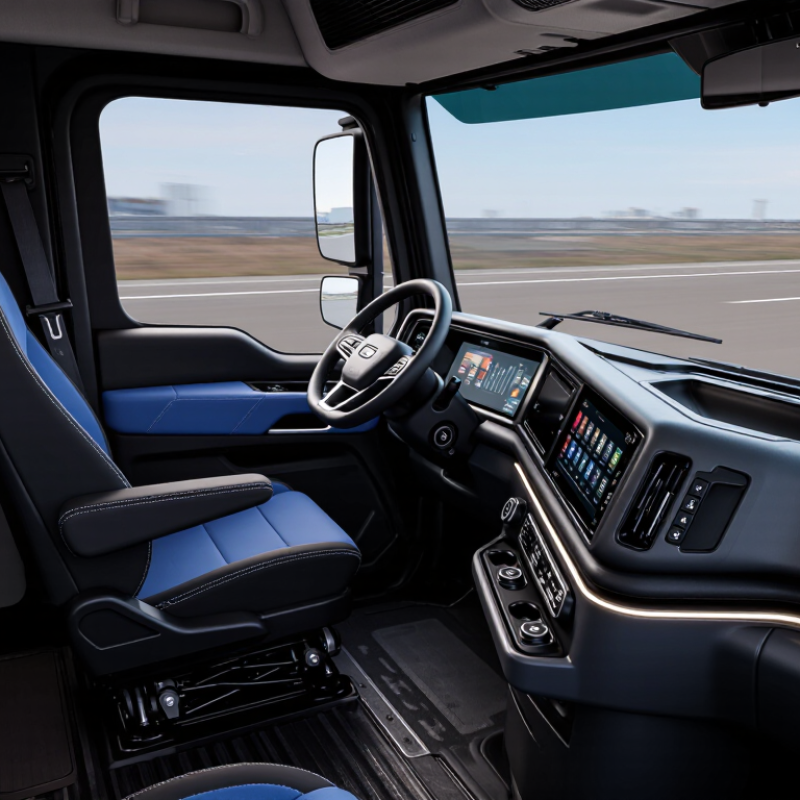
| Driving Posture |
Steering-wheel reach and tilt |
Allow approximately 30–50 mm of fore-aft adjustment and 20–30° of tilt adjustment where packaging permits. |
Helps drivers maintain relaxed shoulders, a supported back, and clear instrument visibility. |
Check the 5th-percentile female through 95th-percentile male driver population using a seating buck. |
SAE J1100 and SAE J1517 occupant-package practices. |
| Driver Seat |
Seat fore-aft travel |
Provide at least 180–220 mm of usable horizontal travel, subject to cab architecture. |
Accommodates a broader driver population and supports correct pedal reach. |
Measure full adjustment range without interference from the steering wheel, pedals, or bunk. |
Vehicle occupant-package design practice; verify against the applicable vehicle class. |
| Driver Seat |
Seat-height adjustment |
Target approximately 50–100 mm of vertical adjustment, including suspension-seat movement where applicable. |
Improves visibility, leg comfort, pedal alignment, and access to controls. |
Confirm eye ellipse, thigh clearance, and pedal access at minimum and maximum settings. |
SAE J1517 and SAE J1100 occupant accommodation methods. |
| Lumbar Support |
Adjustable lumbar-support height and pressure |
Use at least two-way lumbar adjustment; four-way adjustment is preferable for long-haul applications. |
Allows different drivers to support the natural curve of the lower back and reduce fatigue. |
Conduct short- and long-duration evaluations with drivers of different body sizes. |
Ergonomic seating design practice; assess using subjective comfort and posture scores. |
| Seat Cushion |
Cushion length and front-edge support |
Provide adjustable cushion length where possible; maintain clear space behind the knee and avoid concentrated pressure at the cushion edge. |
Reduces pressure under the thighs while preserving support during long driving periods. |
Use pressure mapping and driver feedback at multiple seat positions. |
ISO 2631-1 whole-body-vibration evaluation principles and seating ergonomics practice. |
| Suspension Seat |
Vertical vibration exposure |
Tune the seat and cab suspension to minimize exposure in the dominant operating frequency range; measure weighted RMS acceleration during representative routes. |
Lower whole-body vibration can reduce discomfort and fatigue on rough roads. |
Record seat-base acceleration and calculate daily exposure using a standardized vibration method. |
ISO 2631-1:1997 for evaluation of human exposure to whole-body vibration. |
| Cab Noise |
Interior sound pressure level |
Target a steady-cruise interior level below approximately 70 dB(A), while treating this as a design goal rather than a universal legal limit. |
Supports conversation, audible warnings, concentration, and reduced perceived fatigue. |
Measure at the driver's ear position during idle, acceleration, and steady highway operation. |
ISO 5128 road-vehicle interior-noise measurement practice. |
| Climate Comfort |
Temperature distribution and airflow |
Keep driver-area temperature variation within approximately ±3°C during stabilized operation and prevent direct high-velocity airflow onto the face and hands. |
Reduces hot and cold spots that can cause distraction and discomfort. |
Use temperature sensors at head, chest, and foot levels under hot- and cold-weather test conditions. |
ASHRAE thermal-comfort methods and automotive HVAC test practice. |
| Visibility |
Forward, mirror, and blind-spot visibility |
Maintain clear direct and indirect fields of view across the full seat-adjustment range; minimize mirror obstruction from pillars and interior fittings. |
Reduces neck twisting, repeated head movement, and visual workload. |
Evaluate using regulated mirror and field-of-view procedures plus real-world driver clinics. |
UNECE and applicable regional field-of-view and mirror regulations. |
| Controls and Displays |
Reach distance and operating force |
Place frequently used controls within comfortable seated reach and provide tactile differentiation for critical functions. |
Limits forward leaning, excessive shoulder movement, and visual diversion from the road. |
Measure reach envelopes, activation time, error rate, and glance duration in usability testing. |
ISO 15005 and ISO 15008 road-vehicle human-machine-interface principles. |
| Interior Space |
Headroom and shoulder clearance |
Provide sufficient clearance for helmet or workwear use, natural shoulder movement, and easy entry without contact points. |
Improves entry, exit, seating posture, and perceived spaciousness. |
Verify using 5th- to 95th-percentile accommodation tools and actual work clothing. |
SAE J1100 and SAE J1517 dimensional-package methods. |
| Bunk and Rest Area |
Sleeping-surface length, width, and access |
Design the berth around the intended sleeper population, provide unobstructed access, and avoid hard structural pressure points. |
Supports rest quality and reduces awkward bending or climbing during use. |
Conduct fit checks with representative users, bedding, personal equipment, and emergency egress requirements. |
Applicable vehicle sleeper-compartment and occupant-protection requirements. |
| Storage |
Accessible storage volume and load security |
Place daily-use items between knee and shoulder height where possible; secure heavier items low and close to the vehicle centerline. |
Reduces repeated overhead reaching, clutter, and loose-object hazards. |
Assess reach frequency, opening force, retention, and access while parked and seated. |
Human-factors storage design and applicable interior safety requirements. |
| Entry and Exit |
Step height, grab-handle position, and door opening |
Provide stable, slip-resistant steps and handles that support three-point contact throughout the entry and exit sequence. |
Lowers climbing effort and the risk of slips, trips, and awkward twisting. |
Evaluate with wet and dry surfaces, work boots, low light, and representative users. |
Vehicle access and occupational-safety engineering practices. |
| User-Centered Verification |
Driver comfort and fatigue score |
Use a repeatable 7-point comfort scale and compare scores before and after design changes; set improvement goals by task and route rather than relying on a single universal score. |
Combines objective measurements with the driver's real experience over a complete duty cycle. |
Run controlled clinics and route trials covering short-haul, long-haul, loading, resting, and entry/exit tasks. |
Human-factors validation practice; supplement with ISO 2631-1, ISO 5128, and applicable regulatory tests. |
 Partix Auto