Partix Auto
Rubber components rarely fail without warning. A seal may harden beside a hot engine, while a vibration isolator slowly develops surface cracks. These small changes often begin long before leakage, tearing, or sudden separation becomes visible. For China’s top rubber suppliers, understanding what causes failure in rubber components is essential for safer designs, stable production, and longer service life.
Dr. John S. Dick, a respected rubber technology author and consultant, explains: “Rubber performance is a system result, not a material property alone.” This principle deserves attention. A compound that performs well in laboratory testing may fail in the field because of ozone, oil exposure, compression set, poor bonding, excessive heat, or repeated flexing. Design errors also matter. A sharp groove can cut an otherwise durable seal. Incorrect storage can age rubber before installation.
The evidence is often physical. A brittle edge suggests heat or oxidation. A swollen surface may reveal chemical incompatibility. Fine cracks around a stretched area can indicate ozone attack. Still, diagnosis is not always straightforward. Multiple causes may act together, and supplier assumptions can be wrong. That is where disciplined failure analysis becomes valuable.
This article examines material selection, processing quality, installation conditions, and operating environments. It also considers how experienced Chinese manufacturers inspect defects and improve rubber formulations. The goal is practical understanding, not easy blame. Some failures remain difficult to reproduce. That uncertainty should encourage better testing, clearer specifications, and honest communication between engineers and suppliers.
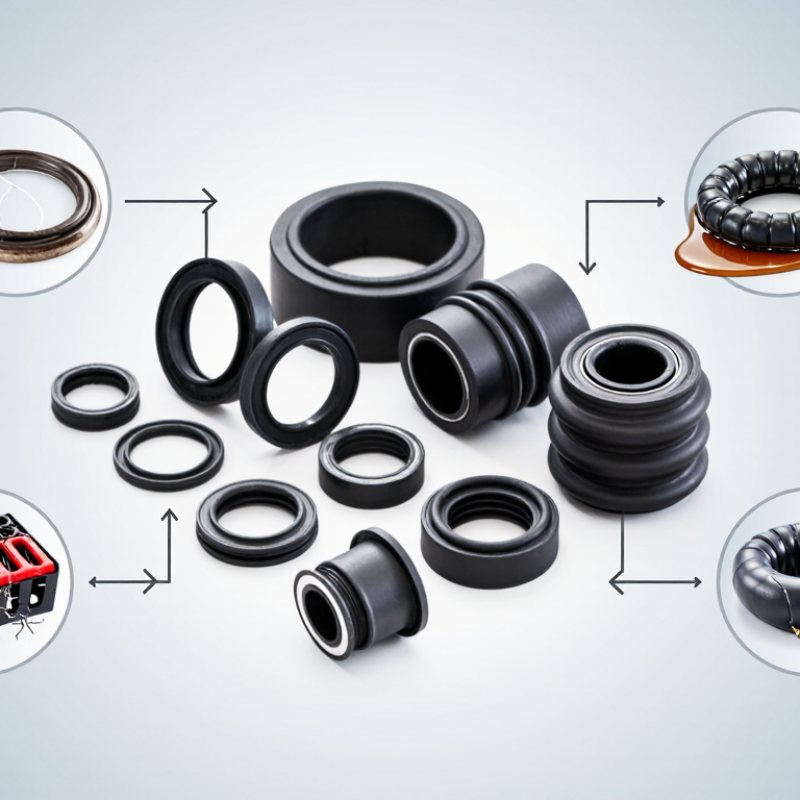
Rubber components are flexible parts made from natural or synthetic rubber compounds. They include seals, gaskets, O-rings, hoses, mounts, bushings, and vibration pads. These parts control movement, block fluids, reduce noise, and absorb impact. You can find them in vehicles, pumps, construction equipment, appliances, medical devices, and industrial machinery.
In practical inspections, I often see a small seal protecting a larger system. An O-ring may sit inside a hydraulic connector. A rubber mount may hold an engine steady while reducing vibration. A hose can carry air, water, oil, or chemicals under changing pressure. Material selection matters. Heat, ozone, sunlight, friction, and fluid exposure can harden or swell rubber. Poor compression can also create leaks. Small defects matter.
Rubber components sometimes fail earlier than expected. The cause may be incorrect dimensions, weak bonding, contamination, or unsuitable storage. I have also seen designs that looked reliable but ignored temperature changes during operation. That deserves more careful review. Reputable suppliers typically check hardness, tensile strength, elongation, compression set, and dimensional accuracy. They may also conduct aging and pressure tests. Still, test results depend on realistic conditions. A laboratory result cannot fully represent every installation, especially when maintenance is irregular or assembly force is uneven.
China Top Rubber Suppliers: Why Do Rubber Components Fail?
Rubber components usually fail through heat, chemicals, fatigue, or poor installation. In service, a seal may harden beside a hot flange, then crack during the next pressure cycle. ISO 815-1 measures compression set, the permanent deformation left after compression. A high result means weaker recovery and a greater leakage risk. ASTM D471 also shows why fluid compatibility matters. Oil can make some compounds swell, soften, or lose tensile strength.
The failure is not always dramatic. A hose may develop tiny surface crazing before it bursts. A mounting bush may become stiff, transferring vibration into nearby metal parts. Abrasion can remove a thin layer every operating cycle. We sometimes blame the rubber too quickly. Incorrect groove dimensions, twisted installation, and trapped air can create the same symptoms. Field temperature records are often incomplete, so diagnosis remains partly uncertain.
Tips: Check the real temperature, pressure, fluid, and movement range. Compare the failed part with ISO 815-1 compression-set data and ASTM D471 fluid-resistance results. Inspect cut surfaces under magnification. Look for gloss, swelling, carbonized edges, or directional wear. Keep installation photographs and service hours. Small records reveal patterns. Do not choose a compound from hardness alone. A 70 Shore A part may still fail if its heat or chemical resistance is unsuitable.
| Failure Mode | Typical Service Cause | Common Rubber Components | Observable Symptoms | Typical Environmental or Operating Conditions | Preventive Measures | Relative Risk |
|---|---|---|---|---|---|---|
| Compression Set | Permanent deformation after prolonged compression, especially when the material operates near or above its recommended temperature range. | O-rings, gaskets, seals, vibration mounts | Loss of sealing force, leakage, reduced recovery after load removal | Continuous compression, elevated temperature, incorrect hardness or cross-section | Select a compound with suitable compression-set resistance; control temperature, squeeze ratio, and groove dimensions. | High |
| Thermal Aging | Heat accelerates chemical changes in the polymer, causing hardening, embrittlement, cracking, or loss of elasticity. | Engine seals, hose covers, electrical grommets, diaphragms | Surface cracks, hard or brittle material, reduced flexibility, leakage | Long-term exposure to high temperature, hot fluids, or repeated heat cycles | Use a temperature-rated elastomer; improve heat dissipation and avoid operation beyond the specified service temperature. | High |
| Ozone and Weather Cracking | Ozone attacks unsaturated polymer chains, particularly when the rubber is stretched during exposure. | Outdoor seals, bellows, tires, flexible hoses, wiper components | Fine cracks perpendicular to the direction of strain, usually on exposed surfaces | Outdoor air, sunlight, ozone-generating equipment, tensile strain | Choose ozone-resistant materials, add appropriate protective systems, and minimize static tensile strain. | Medium |
| Fluid Swelling | Absorption of oils, fuels, solvents, or other liquids causes the rubber to expand and soften. | Fuel seals, hydraulic seals, oil hoses, gaskets | Dimensional growth, softening, extrusion, increased friction, leakage | Incompatible fluid, high fluid temperature, long exposure time | Verify chemical compatibility using the actual fluid, concentration, temperature, and exposure duration. | High |
| Fluid Extraction and Shrinkage | Liquids remove plasticizers or other soluble ingredients from the compound, reducing flexibility and dimensions. | Seals, hoses, flexible connectors, gaskets | Shrinkage, hardening, loss of elasticity, poor contact pressure | Exposure to aggressive solvents, cleaning agents, or incompatible fluids | Use a compound with low extractability and validate the material against the complete chemical exposure profile. | Medium |
| Abrasion and Wear | Mechanical rubbing, sliding, or particle contamination removes material from the surface. | Wiper seals, conveyor components, bushings, dynamic seals | Grooves, thinning, rough surfaces, leakage, increased clearance | High sliding speed, rough surfaces, insufficient lubrication, abrasive particles | Improve surface finish, select a wear-resistant compound, control lubrication and contamination. | High |
| Extrusion and Nibbling | Rubber is forced into a clearance gap by pressure, often followed by cutting or removal during movement. | High-pressure O-rings, hydraulic seals, backup seals | Small pieces missing from the seal, leakage, torn edges, localized damage | High pressure, excessive clearance, low hardness, pressure spikes | Reduce extrusion gaps, use backup rings where appropriate, and select suitable hardness and geometry. | High |
| Tear and Cut Growth | Existing nicks, sharp edges, poor trimming, or excessive stress allow a crack to propagate. | Bellows, diaphragms, molded seals, flexible couplings | Visible tears, split edges, progressive leakage, sudden rupture | Repeated flexing, sharp installation features, high strain, low tear resistance | Remove sharp edges, control surface defects, use proper installation tools, and select high-tear-strength material. | High |
| Fatigue and Flex Cracking | Repeated strain cycles create microscopic damage that grows under continued flexing. | Hoses, bellows, diaphragms, suspension mounts | Cracks at flex points, loss of stiffness, intermittent or final leakage | High cycle frequency, excessive bend radius, vibration, repeated strain | Limit strain amplitude, increase bend radius, avoid sharp transitions, and test expected cycle life. | High |
| Adhesion Failure | Weak bonding between rubber and metal, fabric, or another substrate results from contamination, poor preparation, or processing defects. | Bonded mounts, coated fabrics, rubber-lined parts, bonded seals | Delamination, separation at the interface, movement, noise, loss of function | Contaminated surfaces, incorrect bonding system, moisture, excessive shear load | Control surface preparation, bonding-agent application, molding conditions, and bond-line inspection. | Medium |
| Low-Temperature Embrittlement | The rubber becomes less flexible as temperature approaches or falls below its low-temperature capability. | Cold-environment seals, hoses, gaskets, vibration isolators | Hardening, cracking during movement, poor sealing, delayed recovery | Cold starts, rapid cooling, outdoor winter service, cryogenic exposure | Select a low-temperature-rated compound and verify flexibility at the lowest expected operating temperature. | Medium |
| Installation Damage | Twisting, overstretching, cutting, incorrect lubrication, or installation over sharp edges damages the component before service. | O-rings, lip seals, diaphragms, gaskets, hoses | Immediate leakage, pinched sections, spiral marks, cuts, rolled seals | Improper tools, contaminated grooves, incorrect assembly force, poor alignment | Deburr mating parts, use approved lubricants, follow assembly procedures, and inspect components before installation. | High |
| Decompression Damage | Dissolved gas expands rapidly during pressure reduction and forms internal blisters or cracks. | High-pressure seals, hoses, diaphragms, downhole components | Internal bubbles, surface blisters, cracking, loss of sealing performance | High gas pressure, rapid decompression, gas-permeable elastomer | Control decompression rate, use suitable rapid-gas-decompression-resistant materials, and follow pressure-cycle limits. | Medium |
| Contamination and Chemical Attack | Particles, incompatible cleaning chemicals, moisture, or process contaminants alter the surface or accelerate degradation. | Precision seals, valves, medical or food-contact gaskets, hydraulic components | Swelling, surface deposits, scoring, stiffness changes, premature leakage | Dirty assembly areas, abrasive particles, incompatible cleaners, contaminated fluids | Maintain cleanliness, filter operating fluids, verify cleaning-agent compatibility, and protect parts during storage. | Medium |
China Top Rubber Suppliers: Why Do Rubber Components Fail?
What Causes Rubber Component Failure?
Rubber components rarely fail from one cause. In field inspections, heat is often the first suspect, but incorrect material selection may be the real problem. Oil, cleaning fluids, ozone, and ultraviolet exposure can also weaken rubber over time. A seal near a hot motor may harden, crack, and lose contact pressure. Excessive compression creates permanent deformation, known as compression set. The component then leaks after repeated cycles.
Design and installation errors are equally important. A sharp groove edge can cut an O-ring during assembly. Insufficient clearance may cause extrusion under pressure. Excessive stretching can thin the sealing area and create early fatigue. Contaminated surfaces are another common issue. Small metal particles or dust can form hidden leakage paths. Manufacturing variation matters, too. Uneven curing, air bubbles, or inconsistent dimensions may reduce performance before service begins.
Tips: Match the rubber compound to temperature, pressure, fluids, and movement. Check grooves, tolerances, and surface finish before installation. Store parts away from sunlight, ozone, heat, and compression. Record the failure location and appearance. A cracked surface suggests aging, while tearing may indicate mechanical stress. Do not rely on one test alone. A laboratory result can look reassuring, yet field conditions may be harsher. Experienced engineers still need to question the original assumptions. Sometimes, the overlooked detail is the cause.
When a rubber component fails, diagnosis should begin before the part is discarded. Photograph everything. Record its location, service hours, temperature, pressure, fluid exposure, and assembly date. Compare the failed piece with an unused sample and a part from a working position. Do not guess from cracks alone. A split on the outer edge may indicate ozone attack, excessive stretching, or poor installation.
Clean the surface gently, then inspect cuts, swelling, hardening, flattening, and powdery residue under magnification. Measure dimensions and hardness at several points, because heat can create uneven changes. Check compression set and tensile behavior when laboratory equipment is available. Request material identification through FTIR or similar analysis if contamination or an incorrect compound is suspected. Match the results with technical requirements and relevant ISO or ASTM test methods. Experience helps, but records are stronger than memory.
Trace the operating conditions next. Look for sharp grooves, blocked vents, misalignment, chemical contact, and pressure spikes. A seal that looks worn may actually have been twisted during assembly. Reinstall a verified replacement under controlled conditions and monitor leakage, temperature, and movement. If the replacement fails again, the system may be the real cause. This step is often skipped. It should not be. Diagnosis is not perfect; sampling, aging, and field damage can hide the original evidence.
China’s top rubber suppliers prevent component failure by controlling the entire process, not just checking finished parts. Material selection should match temperature, pressure, chemicals, and movement. An EPDM seal may resist hot water, while it can fail quickly in petroleum oil. That basic mismatch remains common.
Testing must mirror the customer’s real conditions. Suppliers should use ISO 188 for accelerated heat ageing and ISO 1431-1 for ozone resistance. These tests reveal cracking before installation. For pneumatic systems, the U.S. Department of Energy’s Improving Compressed Air System Performance reports that leaks can waste 20–30% of compressor output. A hardened seal may be small, but its cost spreads through energy loss, downtime, and rejected products.
Good factories also control compression, mold temperature, curing time, and flash removal. Each batch needs traceable records, hardness checks, tensile testing, and dimensional inspection. ASTM D2000 helps define rubber grades and performance requirements, but a standard alone cannot replace practical testing. The weakest point may be an overlooked groove edge or a seal installed dry. That assumption can be wrong. Suppliers should inspect samples after thermal cycling, chemical exposure, and repeated compression. China’s rubber manufacturers can improve reliability further by sharing failure photos, assembly feedback, and field-return data with engineers. Some inspections still depend too heavily on visual judgment. More automation would help, though human review remains valuable for unusual defects.
Rubber components are flexible parts made from natural or synthetic rubber compounds. Examples include seals, gaskets, hoses, mounts, bushings, and vibration pads. They control movement, block fluids, reduce noise, and absorb impact.
They appear in vehicles, pumps, appliances, medical devices, construction equipment, and industrial machinery. A small seal may protect an entire hydraulic system.
Heat, ozone, sunlight, friction, and fluids can change rubber performance. Some fluids cause swelling or softening. High temperatures may harden the material. Hardness alone is not enough.
Common causes include heat, chemicals, fatigue, abrasion, poor dimensions, and incorrect installation. A seal may crack after repeated pressure cycles. A hose may show tiny surface lines before bursting.
Twisted seals, sharp grooves, trapped air, uneven compression, and misalignment can create leaks. The rubber may look defective, but the assembly could be responsible. This is easy to overlook.
Photograph the part before discarding it. Record temperature, pressure, fluid exposure, service hours, and assembly date. Compare it with an unused part and a working component. Small records help.
Inspect cracks, swelling, flattening, hardening, powdery residue, gloss changes, and directional wear. Use magnification when possible. Measure hardness and dimensions at several points. Results may vary across one part.
Laboratory testing can examine compression recovery, tensile behavior, fluid resistance, aging, and dimensional accuracy. Material analysis may reveal contamination or an incorrect compound. Test conditions should resemble actual service.
Verify the real temperature, pressure, fluid, movement, and installation force. Use suitable storage conditions and controlled assembly. Monitor leakage, temperature, and movement after replacement. The system may be the problem.
Rubber components are essential in seals, gaskets, hoses, mounts, vibration isolators, and many industrial systems because they provide flexibility, protection, and reliable fluid or air control. However, their performance can decline during service. Common signs of failure include cracking, hardening, swelling, permanent deformation, tearing, leakage, and loss of elasticity. Understanding what causes failure in rubber components requires examining operating temperature, pressure, chemical exposure, friction, ultraviolet radiation, ozone, incorrect installation, and unsuitable material selection.
A systematic diagnosis should begin with a visual inspection, followed by dimensional checks, hardness testing, surface analysis, and a review of service conditions and maintenance records. Comparing failed parts with unused samples can help identify whether the problem resulted from aging, compression set, chemical attack, fatigue, or manufacturing variation. China’s top rubber suppliers can help prevent failure by selecting appropriate compounds, controlling mixing and curing processes, improving mold precision, performing strict quality inspections, and providing design recommendations based on the component’s actual working environment. Clear communication between suppliers and users also supports longer service life and more dependable performance.
